Background
Back in the second year of high school, a friend shared with me a problem that his geometry teacher had shown him.
I was going through a small crisis regarding my future career. I couldn’t decide whether I wanted to pursue a major in the Humanities (Arts or Design were on the top of the list) or in STEM. Before eventually settling down on Physics, I spent quite a lot of time flirting with Math and Science, and tackling this problem was one of the events that helped me choose.
My (very talented) friend took 1 week to solve it. I would take much, much longer, but it would become one of my favorite problems in Mathematics.
The reasons for why I like this problem so much are twofold:
- It can be solved in a multitude of ways;
- It beautifully mixes a lot of the Math skills covered in the high school curriculum.
My first solution to this problem took me about 10 pages.
My second solution, about a year later, took me 1 page.
My final solution, which I would come across while browsing Prof. João Barata’s notes on mathematical physics, took me 1-2 lines.
I would like to share this problem with any Math lovers out there.
The problem statement
Consider a regular polygon with sides. We choose the “radius” of the polygon, ie. the distance between its center of mass and each vertex, to be 1.
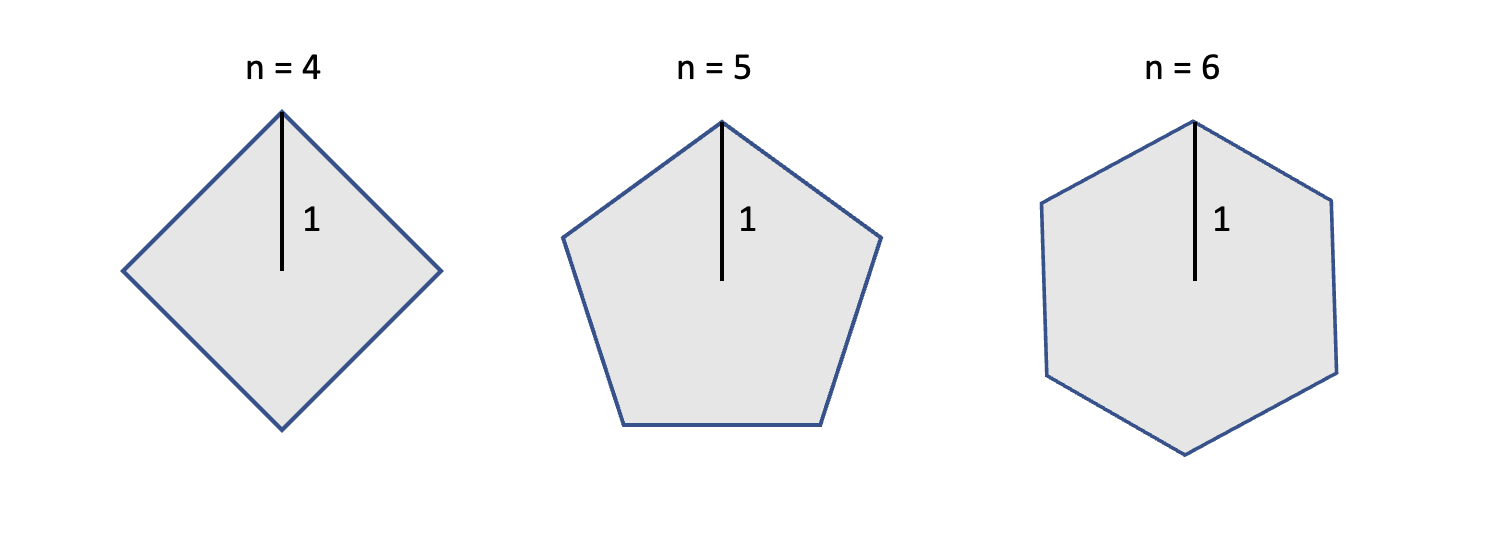
Fix one of the vertices, say . Prove that the product of the distances between and all other vertices is .
Expressed in symbols: let be the vertices of the polygon. Write the distance between vertex and vertex as . Then, we want to prove that
For illustration purposes, let us do the example below:
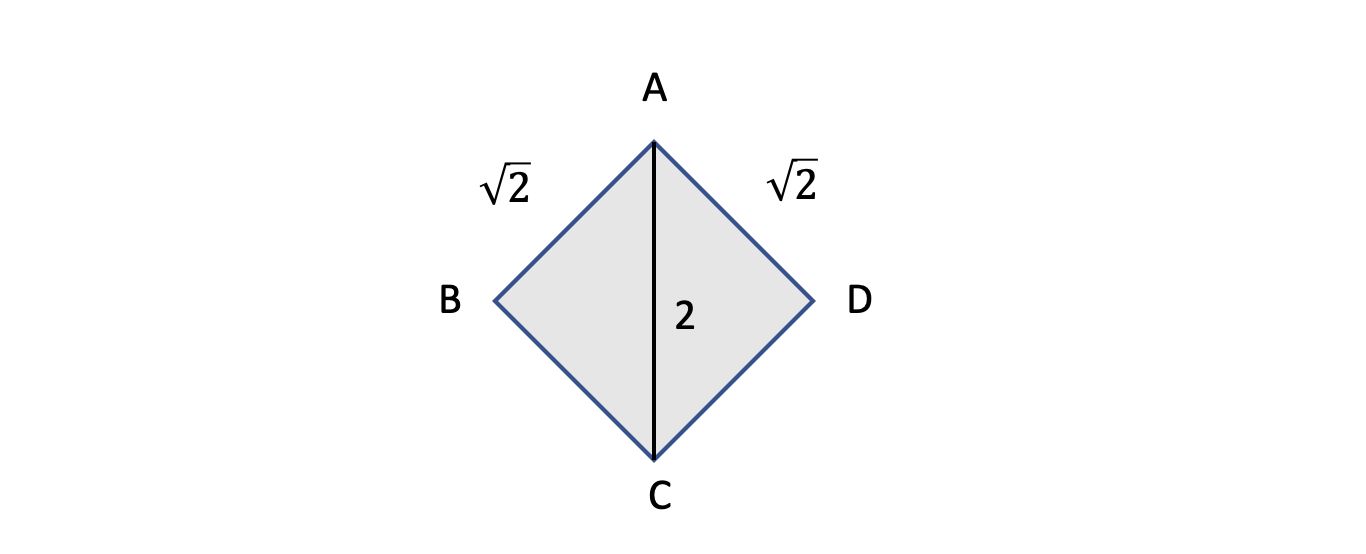
We pick as the upper vertex, and via straightforward geometry we obtain
which yields
so it works in the case.
This is the problem. Go ahead and try to solve it, preferably before reading the solution down below.
The solution
My first insight on how to solve this problem was to map it to the complex plane.
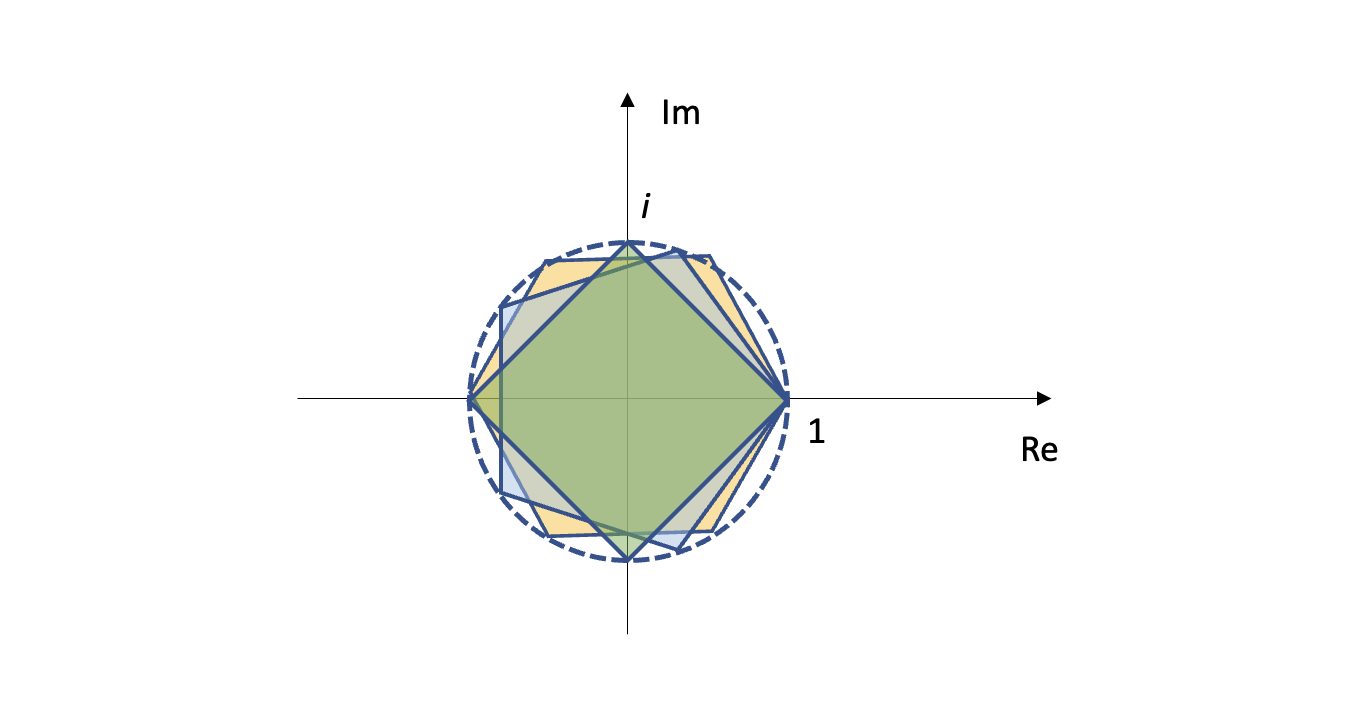
The figure above shows the polygons, rotated so that they have a matching vertex at 1.
A standard result in complex analysis is that the -th roots of unity define a polygon with sides, inscribed in the unit circle. More formally, the equation
has complex roots:
The distance between two complex numbers and is just . Hence, we can elegantly describe the product of the distances from one vertex (which we will pick to be ) to all the others as
Now, , so this is equivalent to
Let us consider the polynomial
Notice that the right-hand side above is just .
Remember that if a polynomial equation has solutions , this means that can be rewritten as
where is a constant. Now, the fact that we are considering the roots of unity means that, by construction,
from which follows
Now, is no longer well-defined, but we can evaluate the limit of this expression as . For that, we can use l’Hôpital’s rule:
Hence, plugging this back on , we get
and the proof is done!
The “one-liner” version:
Final remarks
What I really like about this problem is how it uses complex numbers, in particular the -th roots of unity, to map a difficult geometric problem into an algebraic one. It also requires us to understand complex polynomials and how they are decomposed into their roots. Finally, we obtain the solution via a limit, something that wasn’t so obvious to me in high school. Hope you enjoy this problem the same way I did more than 10 years ago!